Life after the pill: using acupuncture & Chinese medicine to get your cycles in order

Updated: Jun 5
One of the most common situations I see in the clinic is a woman who just came off the pill after years, sometimes a decade or more, and is waiting for her body to figure out what to do next.

Sometimes the period comes back within a month. Sometimes it doesn't come back at all. And very often, it comes back the timing is unpredictable, the flow is different, there's more pain, or new symptoms have shown up that weren't there before.
If this is you, know that this is not unusual and it is not permanent. Your body is recalibrating after years of having its hormonal signaling artificially managed. That takes time. And there's a lot you can do to support the process.
What the pill actually does to your hormones
To understand why coming off the pill can be such a process, it helps to understand what the pill was doing in the first place.
Hormones & Brain
The combined oral contraceptive pill works by introducing synthetic estrogen and progestin into the body continuously, which suppresses the natural hypothalamic-pituitary-ovarian axis.
Your HPO axis is the hormonal command chain that runs your cycle: the hypothalamus sends signals to the pituitary, the pituitary releases FSH and LH, those hormones stimulate the ovaries, the ovaries produce estrogen and progesterone, and all of that feedback governs ovulation, the menstrual cycle, and everything downstream.
The pill essentially takes over that conversation. While you're on it, your hypothalamus and pituitary largely go quiet, because the synthetic hormones tell them they don't need to do anything.
There's no natural FSH surge, no ovulation, no real luteal phase. The bleed that happens during the placebo week is a withdrawal bleed from the synthetic hormones, not a real menstrual cycle.
What can happen after you stop
The range of post-pill experiences is wide, and what you experience depends on several factors: how long you were on the pill, which formulation you were taking, how your cycles were before you started, and whether there were underlying conditions that the pill was masking.
When you stop: the brain reboots
When you stop the pill, your HPO axis has to wake back up and remember how to run things. For most women, that happens within one to three months. For others, particularly those who were on the pill for many years or who had underlying hormonal issues before starting, it can take considerably longer.

When going off the pill, patients often have to deal with what brought them to birth control in the first place.
Most notice the symptoms they were experiencing before taking birth control return with a vengeance. But do not despair, healing is possible.
It takes an average of 3-6 months of acupuncture & herbs at taproot to restore healthier cycles.
Post-pill amenorrhea (no period)
is the most common concern I get asked about. This is when the period simply doesn't return for three months or more after stopping. The reason most often cited is that the body is taking longer to re-establish the hormonal signaling required for ovulation and menstruation. This is not dangerous in most cases, but it is a signal that the system needs support.
Post-pill PCOS
is a phenomenon that has become better recognized in recent years. In some women, stopping the pill reveals a PCOS pattern that was there all along but suppressed by the synthetic hormones. In others, the post-pill hormonal fluctuation seems to trigger an androgen excess pattern that wasn't present before. Either way, the result looks like PCOS: irregular or absent ovulation, elevated androgens, acne, hair changes. Chinese medicine is particularly good at this presentation because the diagnostic framework identifies which pattern is driving it and treats accordingly.
Acne
Acne iss one of the most frequently reported post-pill symptoms and one of the most distressing for patients who came off the pill feeling like they were finally in control of their skin.
The pill suppresses androgen production, which is one of the reasons dermatologists prescribe it for acne. When the pill stops, androgens rebound, sometimes temporarily above pre-pill baseline. This usually settles within a few months, but it can be severe during the transition.
Hair loss
In the months following stopping the pill hair loss is also common and again, very alarming for people who don't know it's coming.
It's related to the same androgen rebound and to the telogen effluvium that happens when the body experiences any significant hormonal shift. It's usually temporary.
Mood changes
Mood swings or changes are another common post-pill experience.
The pill affects serotonin and GABA receptor activity, and stopping it changes those dynamics. Some women feel better off the pill. Some feel worse for months before stabilizing. Some experience anxiety or low mood that they didn't have before.
Cervical mucus changes.
The pill thickens cervical mucus as part of its contraceptive mechanism. Restoring the natural fertile-quality mucus pattern after stopping takes time, and for women trying to conceive, poor or absent cervical mucus can persist for months.
This matters practically because cervical mucus is how sperm survive long enough to reach an egg.
How Chinese medicine thinks about this
In Chinese medicine, the menstrual cycle is governed primarily by the Liver and Kidney systems.
The liver & the kidneys govern your cycle in Chinese medicine
The Liver regulates the smooth flow of qi and blood throughout the cycle.
The Kidneys provide the foundational essence that governs reproductive capacity and the hormonal rhythm underlying the cycle.
These two systems map onto the HPO axis in Western medicine terms, which is why the clinical correlations are so consistent.
Patterns when stopping the pill
Years of hormonal birth control, in Chinese medicine terms, suppresses the natural movement of Liver qi and puts the Kidneys in a kind of dormancy.
When the pill stops, the most common patterns I see are
Liver qi stagnation (the system trying to reassert its natural rhythm but meeting resistance)
Kidney deficiency (the foundational hormonal resources are depleted or slow to reactivate)
blood deficiency (the real menstrual cycle needs to rebuild sufficient blood and yin to function).
The specific pattern varies by patient, which is why the treatment is individualized. A patient whose main post-pill presentation is absent periods with fatigue and scanty previous cycles has a different pattern than a patient whose main presentation is severe acne, irregular ovulation, and irritability. The herbs and acupuncture point selection are different for each.
What treatment looks like at taproot
The phase-based approach from the original post is the right framework, so I want to keep it and expand it.

A treatment based on the 4 phases of your cycle
Chinese medicine treats the cycle in four phases, and the treatment shifts accordingly within each one:
menstruation (your flow)
follicular phase (before ovulation)
ovulation (mid cycle)
luteal phase (after ovulation)
During menstruation, the focus is on supporting smooth, complete shedding of the lining. Post-pill periods are often irregular in flow, whether scanty and pale (blood deficiency pattern) or heavier with clotting (stagnation pattern).
Acupuncture during the bleed helps regulate the flow, reduce cramping, and prevent spotting that lingers after the main bleed is finished.
After bleeding stops, the follicular phase begins. This is the time to rebuild blood and yin, support the developing follicle, and encourage the lining to thicken appropriately
. For post-pill patients, this is often the phase where the most work is needed. The pill depletes blood and yin over time, and rebuilding those resources is what allows the cycle to function properly. Herbs prescribed in this phase are typically blood-nourishing and yin-tonifying.
Around ovulation, the focus shifts to supporting the transition from yin to yang, encouraging a clear LH surge, and supporting the release of a healthy egg.
Post-pill cycles often have delayed or absent ovulation even when the period has returned, because the surge of LH required for ovulation is one of the things the HPO axis takes longest to re-establish. Acupuncture around the expected ovulation window supports this transition.
In the luteal phase, the focus is on warming and sustaining the second half of the cycle, supporting progesterone production, and maintaining the implantation environment for women trying to conceive.
Post-pill luteal phases are frequently short or insufficiently supported, which is why many post-pill patients experience spotting before their period starts, short cycles, or the feeling that their second half just collapses quickly.
The herbs
As with everything in Chinese medicine, the formula depends on the pattern. But for post-pill patients specifically, the most commonly indicated frameworks are:
Blood nourishing herbs to rebuild the blood depleted by years of synthetic hormones and to support lining development
dang gui (angelica sinensis)
bai shao (white peony)
shu di huang (prepared rehmannia).
Liver qi moving herbs to get things moving again when the cycle is stuck, irregular, or accompanied by premenstrual irritability and breast tenderness.
chai hu (bupleurum)
xiang fu (cyperus) .
Kidney tonifying herbs
tu si zi (cuscuta seed)
xu duan (teasel root)
du zhong (eucommia bark)
The formula changes as the pattern shifts.
A patient who starts treatment with amenorrhea and a kidney and blood deficiency pattern will have a different formula by month three, when her cycle has partially returned but she's dealing with a short luteal phase. This is normal and expected. The herb prescription follows where the patient is, not where she started.
Nutrition and lifestyle during the transition
A few things I always cover with post-pill patients that make a real difference:
Support your gut
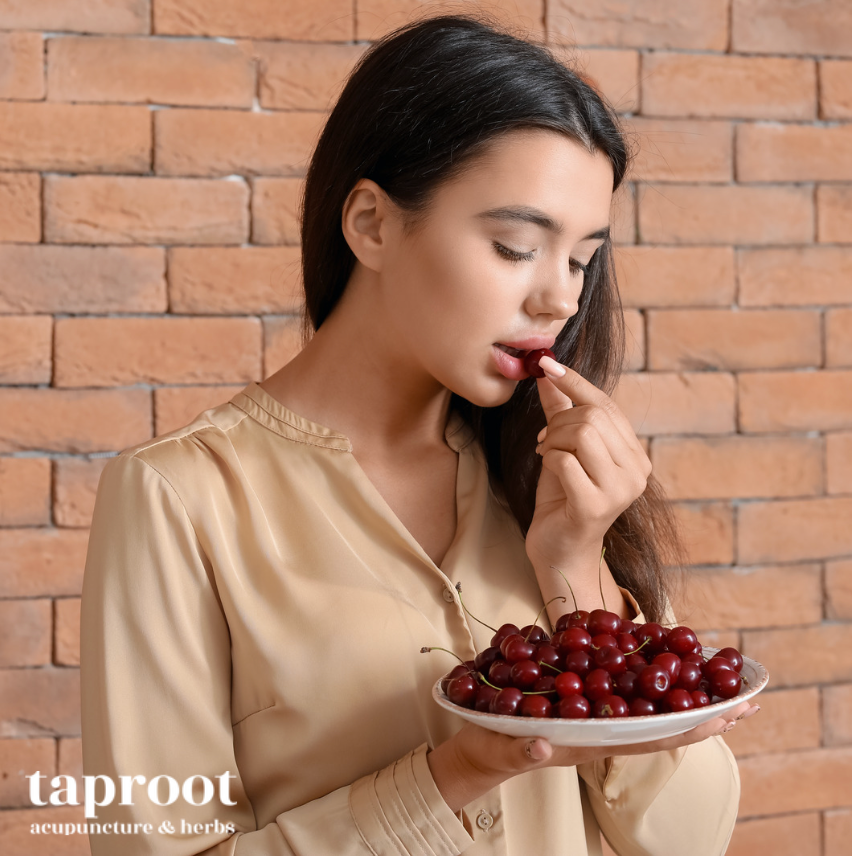
The pill has a documented effect on the gut microbiome, reducing the bacterial diversity that supports healthy estrogen metabolism. Fermented foods daily, prebiotic fiber, and reducing inflammatory foods are more impactful here than at other times.
Eat for blood building
Real iron from food matters: organic red meat two to three times a week, dark leafy greens daily, lentils and legumes, beets. Pair iron-rich foods with vitamin C.
Reduce the things that suppress cycle recovery
Excessive exercise, very low calorie intake, and chronic stress all suppress the HPO axis. If you're training hard, eating very little, or under significant sustained stress, your cycle may take longer to return than it would otherwise. This is not a judgment, it's physiology.
Track your cycle
Basal body temperature charting is the most informative tool for understanding what your cycle is actually doing month to month, and it's the tool I use most with post-pill patients to track treatment progress. Ovulation predictor kits fill in the gaps. Apps are fine for recording data. We talk through how to interpret your chart at your appointments.
How long does recovery take with acupuncture?
The honest answer is: it varies a lot, and it depends on how long you were on the pill, which formulation, and what was going on with your cycle before you started.
If your cycles were regular before the pill and you were on it for a few years for contraception only, recovery is usually faster, often within two to three cycles of starting treatment.
If you were put on the pill in your teens to manage a painful or irregular cycle, the underlying pattern that drove those symptoms was never resolved. It was suppressed.
Coming off the pill often means meeting that original pattern again for the first time in years, plus whatever the pill added on top. These patients take longer, sometimes six months or more, and the work is as much about resolving the original pattern as it is about the post-pill transition.
If you are trying to conceive, I generally recommend waiting at least one to three natural cycles before actively trying, both to allow the lining and hormonal environment to rebuild and to give you a clearer picture of what your cycle is actually doing. Exceptions exist, and we discuss timing case by case.
With acupuncture weekly for the first two to three months, Chinese herbs prescribed to your pattern, and the dietary and lifestyle support above, most patients see meaningful cycle improvement within three months. Some see it faster. Some need longer. There's no single timeline, but there is a reliable direction of travel.
FAQ
My period came back after stopping the pill but it's completely different from before. Is that normal?
Very common. The first few cycles post-pill are often different in flow, timing, and symptom profile from what you experienced before. Some women experience heavier periods as the lining rebuilds after years of thin pill-induced bleeds. Some experience more cramping, more clotting, more premenstrual symptoms. This typically settles as the body finds its natural rhythm again. If it doesn't settle within three to four cycles, or if symptoms are severe, that's worth looking at more closely, because it may indicate an underlying pattern that needs treatment rather than more waiting.
I stopped the pill three months ago and still have no period. When should I be worried?
At three months without a period post-pill, it's worth getting a workup from your OB or RE to rule out other causes (thyroid, prolactin, PCOS) before assuming it's purely post-pill. You don't need to wait until six months to be seen. Start acupuncture alongside that workup rather than sequentially. Three months of treatment while you get the labs done is more efficient than doing them one after the other.
Can acupuncture help post-pill acne?
Yes, and this is one of the faster-responding post-pill symptoms in my experience. The androgen excess pattern driving post-pill acne is something Chinese medicine treats well. Herbs that clear liver heat and reduce androgen-related patterns, combined with dietary changes (reducing dairy and high-glycemic foods specifically), produce visible skin improvement within six to eight weeks in most patients. Full resolution takes longer, but the trajectory is usually clear within two months.
I've been off the pill for six months, my period is back, but I'm not getting pregnant. Is the pill affecting my fertility?
Six months post-pill, with regular periods returned, the pill itself is unlikely to be the primary fertility obstacle. At that point, the question is what your cycle quality actually looks like: Are you ovulating? Is your luteal phase adequate? Is your lining developing properly? Is your cervical mucus fertile-quality? These are things we assess through cycle tracking and clinical evaluation. Come in for a full intake so we can look at what's actually happening rather than continuing to attribute everything to the pill.
Is it safe to take Chinese herbs after stopping the pill?
Yes, and the transition off the pill is actually a particularly good time to start herbal support. The two most important considerations are that herbs should be prescribed by a qualified practitioner, not chosen off an online list, and that the formula needs to be reviewed and adjusted as your cycle changes. A formula that was appropriate for amenorrhea is not necessarily appropriate once your period has returned, and a luteal phase formula is different from a follicular phase formula. This is why I don't recommend generic post-pill supplement protocols, because they don't move with you the way a properly prescribed formula does.
Acupuncture for stopping the pill in Pasadena
If you're in the Pasadena area and you're navigating the post-pill transition, whether your period hasn't returned, your cycle is all over the place, or you're trying to get your body ready to conceive, come in. You can book a new patient appointment online or call us at 626-841-2991.
For more on the full range of women's health conditions we treat, including PCOS, endometriosis, and perimenopause, the women's health page has the detail. And if you're planning to conceive after coming off the pill, the natural fertility page covers how we approach preconception preparation.


Comments